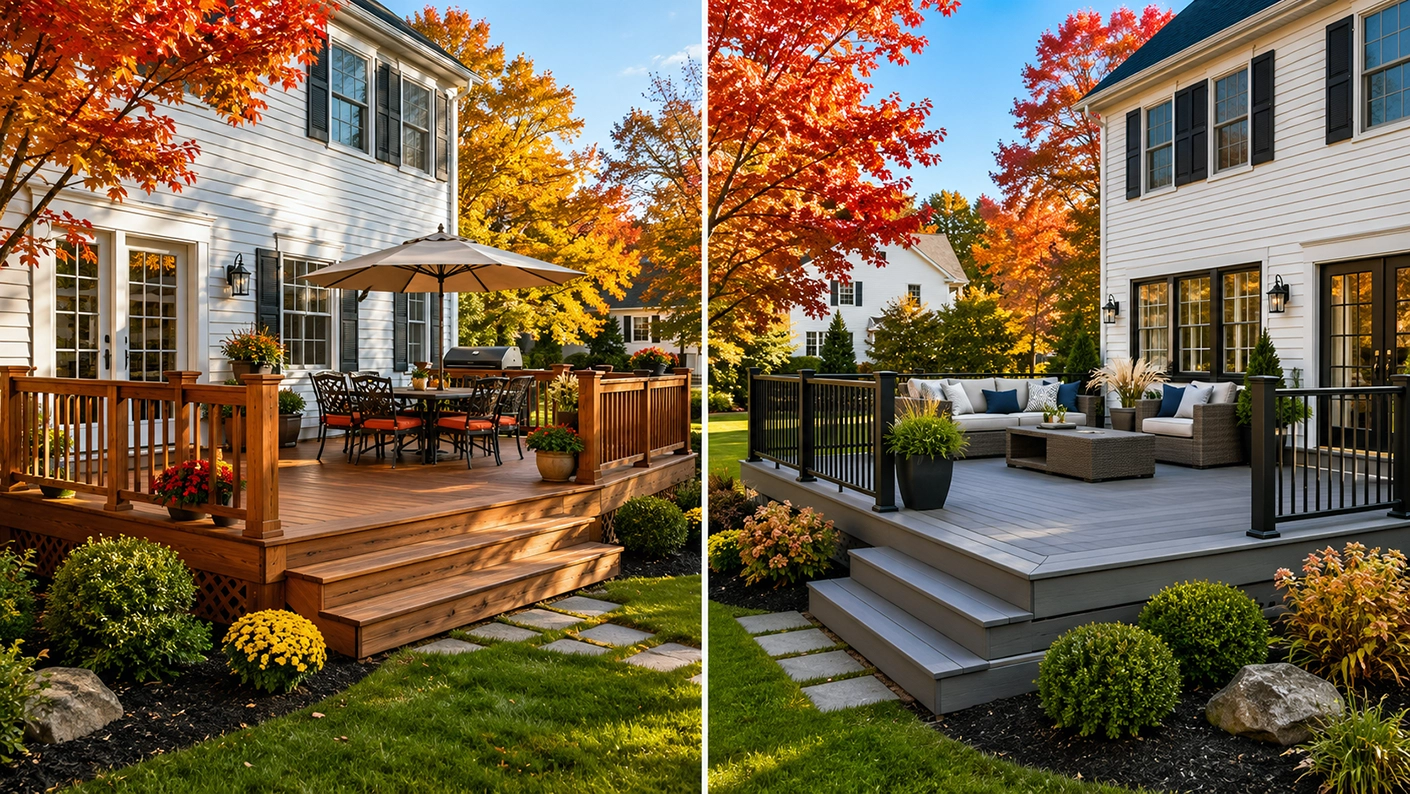
If you’re planning a new deck for your home, one of the biggest decisions you’ll make is choosing the right decking material. For homeowners throughout Massachusetts and the Merrimack Valley, the debate often comes down to composite vs treated wood deck options.
Both materials have advantages, and both can create a beautiful outdoor space. However, New England’s climate presents unique challenges that make material selection especially important. Snow, ice, moisture, direct sunlight, humidity, and freeze-thaw cycles can all affect the appearance, durability, maintenance requirements, and long-term cost of your deck.
Some homeowners prefer the natural appearance of a traditional wood deck. Others are drawn to the low maintenance benefits of composite decking. The right choice depends on your budget, maintenance expectations, design preferences, and how long you plan to remain in your home.
In this guide, we’ll compare composite decking and pressure treated wood to help you determine which option is best for your property in Tewksbury and throughout New England.
Understanding the Two Most Popular Decking Materials
Before comparing performance, it’s important to understand how these decking materials differ.
What Is Composite Decking?
Composite decking is a manufactured decking product made from a blend of wood fibers and plastic. These composite materials are combined to create deck boards that mimic the appearance of natural wood while offering enhanced resistance to moisture, insects, and rot.
Today’s composite decking products come in a wide variety of colors, textures, and styles. Many manufacturers create decking lines that closely resemble cedar, hardwood, redwood, and even exotic species like ipe.
One of the reasons composite decking has become so popular is that it offers the appearance of a wood deck without many of the maintenance requirements associated with natural lumber.
Most composite decking products feature a protective cap that helps resist fading, staining, mold, and moisture penetration. This makes composite decking particularly attractive to homeowners seeking a low maintenance outdoor space.
Several manufacturers produce composite decking, but Trex remains one of the most recognized names in the industry. Trex makes numerous decking lines designed for different budgets and performance expectations.
What Is Pressure-Treated Wood?
Pressure treated wood is natural lumber that has been infused with preservatives under pressure to protect it from rot, insects, and moisture damage.
Pressure treated lumber is commonly used throughout New England because it offers a lower cost alternative to composite decking while providing good structural performance.
A pressure treated deck typically uses pressure treated lumber for both the framing and the visible deck boards. Because pressure treated wood begins as real wood, it retains the natural grain patterns and character that many homeowners prefer.
Compared to composite decking, a pressure treated deck generally has a lower upfront cost. However, pressure treated materials require regular maintenance to maintain appearance and longevity.
Many homeowners also consider other wood options such as cedar, redwood, and ipe. Cedar remains popular because of its natural beauty and resistance to insects, while ipe is an extremely dense hardwood known for exceptional durability. However, both cedar and ipe typically cost significantly more than pressure treated lumber.
Wood vs Composite: Understanding the Core Differences
When evaluating wood vs composite products, the primary differences involve maintenance, longevity, appearance, and overall cost.
A traditional wood deck offers authentic natural beauty and can be customized through staining and painting. Composite decking, on the other hand, is engineered to provide greater durability and lower upkeep requirements.
Wood vs composite comparisons often focus on:
- Initial cost
- Long-term maintenance
- Resistance to rot
- Resistance to insects
- Appearance
- Lifespan
- Repair requirements
- Heat retention
For some homeowners, the natural appearance of a wooden deck is worth the additional maintenance. For others, the convenience of composite decking outweighs the higher upfront investment.
How New England Weather Affects Deck Performance
The climate throughout Massachusetts places unique demands on decking materials.
Freeze-Thaw Cycles
Winter weather can be especially hard on a wood deck.
As moisture enters wood fibers and freezes, expansion occurs. Over time, repeated freeze-thaw cycles can contribute to cracking, splitting, and surface deterioration.
Pressure treated wood is more resistant than untreated lumber, but it can still experience wear from years of weather exposure.
Composite decking generally performs well during freeze-thaw cycles because composite materials absorb less moisture than natural wood.
Snow, Ice, and Moisture Exposure
New England decks endure significant moisture exposure throughout the year.
Snow accumulation, ice dams, spring rainstorms, and humid summer conditions all place stress on decking systems.
A pressure treated deck is designed to resist moisture, but prolonged exposure can still contribute to rot and mold if maintenance is neglected.
Composite decking offers strong resistance to moisture and is less prone to rot than a traditional wood deck.
This is one reason many homeowners choose composite decking for properties that receive heavy snow or experience frequent wet conditions.
Direct Sunlight and Summer Heat
While winters are challenging, summer conditions can create their own issues.
Deck surfaces exposed to direct sunlight can become hot during peak summer months. Dark-colored composite decking products may retain more heat than lighter-colored materials.
Some composite board products become noticeably hot when exposed to direct sun for extended periods. This can be uncomfortable for bare feet during the hottest part of the day.
However, manufacturers continue improving composite board technology to reduce heat retention.
A pressure treated deck may remain somewhat cooler than certain composite products, although direct sunlight affects all decking surfaces.
Homeowners should also consider shade patterns when selecting decking colors and materials.
Insects and Biological Threats
Another concern for New England homeowners is insect activity.
Natural wood can be vulnerable to insect damage over time, particularly when maintenance is neglected.
Pressure treated lumber is specifically designed to resist insects and decay. However, no wood product is completely immune to long-term deterioration.
Composite decking contains plastic and engineered composite materials that are generally resistant to insect damage. This helps reduce concerns about termites and other wood-destroying insects.
Long-Term Weather Exposure
Whether you choose pressure treated wood or composite decking, years of exposure to sun, moisture, snow, and changing temperatures will eventually affect performance.
The difference lies in how much maintenance is required to maintain appearance and structural integrity.
A pressure treated deck requires regular maintenance that may include cleaning, staining, sealing, sanding, and occasional repairs.
Composite decking typically requires minimal maintenance beyond periodic cleaning.
This difference in upkeep is one of the primary reasons composite decking continues gaining popularity among homeowners throughout Massachusetts.
Composite Decking: Pros and Cons for New England Homes
As composite decking continues to gain popularity throughout New England, many homeowners are asking whether the higher upfront cost is worth the investment.
The answer depends on your goals, budget, and expectations for long-term maintenance. While composite decking generally costs more initially than pressure treated wood, it offers several advantages that make it attractive for homeowners seeking a low maintenance outdoor space.
Advantages of Composite Decking
Exceptional Moisture Resistance
One of the biggest benefits of composite decking is its resistance to moisture.
Unlike a traditional wood deck, composite decking absorbs very little water. This helps reduce the risk of rot, mold, warping, and structural deterioration over time.
In New England, where decks experience snow, rain, humidity, and freeze-thaw cycles, moisture resistance can significantly impact long-term durability.
Many composite board products are specifically engineered to remain resistant to moisture infiltration even after years of exposure to harsh weather conditions.
Low Maintenance Requirements
For many homeowners, the biggest selling point of composite decking is its low maintenance nature.
Unlike pressure treated wood, composite decking does not require:
- Regular staining
- Frequent sealing
- Painting
- Extensive sanding
A simple cleaning once or twice per year is often sufficient to maintain appearance.
Because composite decking requires minimal maintenance, many homeowners find the higher upfront cost easier to justify over the life of the deck.
Resistance to Rot and Splinters
One challenge with a wood deck is that natural wood can eventually develop splinters, cracks, and surface deterioration.
Composite decking eliminates many of these concerns.
Because composite decking contains plastic and engineered composite materials, it is highly resistant to rot and generally won’t develop the splinters commonly associated with aging wood.
For families with children who frequently walk barefoot outdoors, avoiding splinters can be a significant advantage.
Long-Term Appearance Retention
Many composite decking products maintain their appearance for years with minimal upkeep.
Modern composite board technology helps resist:
- Fading
- Staining
- Moisture damage
- Surface wear
As a result, composite decking often retains a more consistent appearance than pressure treated wood over time.
Trex and other leading manufacturers continue improving color retention and surface performance. Trex makes products in a wide range of colors designed to complement virtually any home style.
Excellent Durability
Durability is another major advantage.
Composite decking is designed to withstand years of weather exposure with relatively little deterioration. While no decking product is indestructible, composite decking is often considered one of the most durable decking materials available.
Many manufacturers back their composite decking products with warranties lasting 25 years or longer.
Disadvantages of Composite Decking
Higher Initial Cost
The biggest drawback of composite decking is cost.
Compared to pressure treated wood, composite decking typically costs substantially more upfront.
Depending on the brand, product line, and design selections, composite decking may cost nearly twice as much—or even more—than a pressure treated deck.
For budget-conscious homeowners, this higher cost can be difficult to justify initially.
Heat Retention
One criticism of composite decking is that certain colors can become hot during summer months.
Dark-colored composite products exposed to direct sunlight often absorb more heat than lighter colors.
During periods of direct sun exposure, some composite decking surfaces can become quite hot under bare feet.
Fortunately, many manufacturers now offer lighter color options that help reduce heat absorption.
Homeowners should carefully consider sun exposure and shade patterns when selecting colors.
Appearance Preferences
Although composite decking has improved dramatically, some homeowners still prefer the appearance of natural wood.
A pressure treated deck, cedar deck, or ipe hardwood deck offers unique grain patterns that some people find more attractive than manufactured alternatives.
For homeowners who strongly value authentic wood aesthetics, pressure treated wood may still be the preferred choice.
Pressure-Treated Wood Decks: Pros and Cons for New England Homes
Pressure treated wood remains one of the most commonly used decking materials in New England.
For decades, pressure treated lumber has been the standard choice for residential deck construction because it combines affordability with proven performance.
Advantages of Pressure-Treated Wood
Lower Initial Cost
One of the primary reasons homeowners choose pressure treated wood is its lower cost.
Compared to composite decking, pressure treated lumber is generally far more affordable.
For larger projects involving extensive decking, railings, stairs, and multiple levels, the savings can be substantial.
A pressure treated deck often allows homeowners to build a larger outdoor space while staying within budget.
Natural Wood Appearance
Many homeowners simply prefer real wood.
A pressure treated deck offers natural grain patterns, texture, and warmth that manufactured materials may not fully replicate.
Pressure treated wood can also be customized through:
- Staining
- Painting
- Sanding
- Decorative finishes
This flexibility allows homeowners to create a truly customized appearance.
Easier Board Replacement
Another advantage of pressure treated lumber is the simplicity of repairs.
If individual boards become damaged, it is often relatively easy to replace affected sections without disturbing the rest of the deck.
With composite decking, matching colors years later can occasionally be more challenging if product lines have changed.
Disadvantages of Pressure-Treated Wood
Ongoing Maintenance Requirements
The biggest drawback of pressure treated wood is maintenance.
Unlike composite decking, pressure treated wood requires regular maintenance to preserve its appearance and structural integrity.
Most pressure treated decks require:
- Staining every few years
- Sealing on a regular schedule
- Periodic sanding
- Cleaning
- Inspection for wear
A pressure treated deck requires regular maintenance throughout its lifespan.
While these tasks are manageable, they add both time and cost over the years.
Greater Risk of Rot and Moisture Damage
Although pressure treated lumber is designed to resist decay, it is still wood.
Over time, moisture exposure can contribute to:
- Rot
- Cracking
- Splinters
- Surface deterioration
Areas that remain damp for extended periods are especially prone to wear.
This is why proper drainage, ventilation, and maintenance are so important for a pressure treated deck.
Vulnerability to Weathering
Years of exposure to sun, snow, rain, and temperature fluctuations can affect the appearance of pressure treated wood.
Without proper maintenance, boards may fade, crack, or develop surface imperfections.
Many homeowners find that maintaining a pressure treated deck becomes more demanding as the structure ages.
Composite vs Pressure Treated: Side-by-Side Comparison
Initial Cost
Winner: Pressure Treated Wood
Pressure treated lumber offers the lowest upfront cost and remains one of the most affordable decking materials available.
Long-Term Maintenance
Winner: Composite Decking
Composite decking requires minimal maintenance, while pressure treated wood requires ongoing staining, sealing, sanding, and upkeep.
Resistance to Rot and Insects
Winner: Composite Decking
Composite decking is highly resistant to rot, moisture, and insects.
Appearance
Tie
Some homeowners prefer the authentic appearance of wood. Others prefer the consistent appearance of composite decking.
Repairs
Winner: Pressure Treated Wood
Individual boards can often be replaced more easily on a pressure treated deck.
Durability
Winner: Composite Decking
Composite decking generally offers superior durability and longer service life.
Long-Term Value
Winner: Composite Decking
Although the initial cost is higher, reduced maintenance expenses often make composite decking an attractive long-term investment.
When evaluating wood vs composite products, homeowners should focus not only on upfront cost but also on future maintenance, repairs, and expected lifespan.
Which Decking Material Lasts Longer in New England?
When comparing composite decking and pressure treated wood, lifespan is often one of the most important considerations.
While upfront cost certainly matters, homeowners should also think about how long their decking investment is expected to last and what level of maintenance will be required along the way.
Expected Lifespan of Composite Decking
Most composite decking products are designed to provide decades of reliable performance.
Depending on the manufacturer, installation quality, and environmental conditions, composite decking typically lasts 25 to 50 years or more.
Many composite decking manufacturers offer warranties ranging from 25 years to lifetime coverage on certain product lines. Trex remains one of the industry’s leading brands, and Trex makes several product tiers designed to meet different performance and budget requirements.
The longevity of composite decking is largely due to its resistance to:
- Rot
- Moisture
- Insects
- Cracking
- Splinters
- UV exposure
Because composite decking is engineered using composite materials and plastic components, it experiences less deterioration than many traditional wood products.
Expected Lifespan of a Pressure Treated Deck
A properly maintained pressure treated deck can also provide many years of service.
Most pressure treated wood decks last approximately 15 to 25 years, although lifespan varies depending on maintenance, drainage, sun exposure, and installation quality.
Pressure treated lumber is specifically designed to resist rot and insects, but it remains a natural wood product. Over time, weather exposure, moisture, and normal wear can affect performance.
The lifespan of a pressure treated deck often depends on how consistently homeowners maintain the structure.
Proper:
- Staining
- Sealing
- Sanding
- Cleaning
- Repairs
can dramatically extend the life of pressure treated wood.
Factors That Influence Deck Longevity
Regardless of whether you choose composite decking or pressure treated wood, several factors influence lifespan.
Installation Quality
Even the best materials can underperform if they aren’t properly installed.
Proper spacing, ventilation, drainage, flashing, and framing all play critical roles in deck longevity.
Moisture Management
Moisture remains one of the biggest threats to any outdoor structure.
Poor drainage can accelerate rot in pressure treated lumber and may even affect composite decking performance over time.
Sun Exposure
Continuous exposure to direct sunlight can affect all decking materials.
While composite decking is designed to resist fading, prolonged direct sun exposure can still contribute to surface wear over decades.
Maintenance Practices
Maintenance directly affects longevity.
A pressure treated deck that receives regular maintenance will often outlast a neglected one by many years.
Which Option Provides Better Long-Term Value?
When evaluating wood vs composite products, it’s important to look beyond initial cost.
Many homeowners focus on the upfront price of decking materials without considering the long-term financial picture.
Looking Beyond Initial Cost
At first glance, pressure treated wood often appears to be the clear winner because of its lower cost.
However, over the life of the deck, ongoing maintenance expenses can narrow the gap.
Pressure treated wood requires:
- Regular staining
- Sealing
- Sanding
- Cleaning
- Periodic repairs
- Board replacement
These recurring expenses add up over time.
Composite decking requires far less maintenance and generally involves lower long-term upkeep costs.
Total Cost of Ownership
When calculating total ownership cost, homeowners should consider:
- Initial materials cost
- Installation cost
- Maintenance expenses
- Repair costs
- Replacement costs
A pressure treated deck may cost less initially, but decades of staining, sealing, painting, sanding, and repairs can significantly increase total ownership expenses.
Composite decking often requires a larger upfront investment but may save money over time due to reduced maintenance.
For many homeowners, the long-term value equation favors composite decking.
Return on Investment Considerations
Return on investment depends on buyer preferences and local market expectations.
In many New England communities, modern composite decking products are viewed favorably because buyers appreciate low maintenance features.
A beautiful composite deck can help transform an outdoor space and increase overall property appeal.
That said, a well-maintained pressure treated deck can also provide excellent value and strong return on investment.
The best choice depends on your goals, budget, and how long you plan to remain in the home.
Best Uses for Composite Decking
Composite decking isn’t necessarily the right solution for every project.
However, it tends to perform particularly well for certain homeowners and property types.
Composite Decking Is Ideal For:
- Busy homeowners
- Vacation property owners
- Waterfront homes
- Homes exposed to significant moisture
- Homeowners seeking minimal maintenance
- Families who want fewer splinters
- Long-term homeowners
Because composite decking requires very little upkeep, it is often an excellent choice for people who would rather spend time enjoying their deck than maintaining it.
A composite board surface also provides consistent appearance year after year with relatively little effort.
Composite Decking Works Well For:
- Large entertaining decks
- Multi-level decking systems
- Pool decks
- Waterfront properties
- Elevated decks
- Outdoor living spaces
If your goal is building a dream deck with minimal maintenance requirements, composite decking is often worth serious consideration.
Best Uses for Pressure-Treated Wood Decking
Pressure treated wood remains an excellent option for many projects.
Pressure Treated Wood Is Ideal For:
- Budget-conscious homeowners
- First-time homeowners
- DIY enthusiasts
- Investment properties
- Large decks where cost is a major concern
The lower cost of pressure treated lumber allows homeowners to build larger structures without exceeding their budget.
Pressure Treated Decks Work Well For:
- Starter homes
- Rental properties
- Traditional home styles
- Projects where future customization is important
Because pressure treated wood accepts staining and painting, it provides flexibility that some homeowners prefer.
Many people simply enjoy the natural appearance and feel of a traditional wooden deck.
Frequently Asked Questions About Decks
Does Composite Decking Get Hot?
Yes, some composite decking products can become hot when exposed to direct sunlight for extended periods.
Lighter colors generally remain cooler than darker colors.
Is Composite Decking Slippery?
Most modern composite decking products are manufactured with textured surfaces designed to improve traction.
How Often Does a Pressure Treated Deck Need Staining?
Most pressure treated decks benefit from staining every two to five years depending on weather conditions and sun exposure.
Can Composite Decking Develop Splinters?
No. One major advantage of composite decking is that it does not typically develop splinters like natural wood.
Which Option Is Better: Wood vs Composite?
There is no universal answer.
Wood vs composite decisions should be based on budget, maintenance preferences, appearance goals, and long-term ownership plans.
Final Verdict: Composite vs. Pressure-Treated Wood Decks for New England
When comparing composite decking vs composite alternatives and traditional pressure treated wood options, there’s no one-size-fits-all answer.
If your priority is lower upfront cost, natural wood appearance, and design flexibility, a pressure treated deck may be the right choice. Pressure treated lumber remains a proven building material that continues to perform well throughout New England.
If your priority is durability, minimal maintenance, resistance to rot, and long-term convenience, composite decking is often the better investment.
Many homeowners ultimately find that composite decking delivers greater long-term value despite the higher initial cost because of reduced maintenance requirements and excellent durability.
The best decking solution is the one that aligns with your budget, lifestyle, and long-term goals.
If you’re considering a new deck in Tewksbury or anywhere throughout the Merrimack Valley, the team at Bradley’s Building Solutions can help you compare decking materials, evaluate design options, and create a deck that complements your home and outdoor space. As experienced deck contractors serving Tewksbury and the surrounding Merrimack Valley area, we can help you determine whether composite decking or pressure treated wood is the right choice for your project and help bring your vision to life with quality craftsmanship and professional installation.